The Practice of Adaptive Leadership: Tools and Tactics for Changing Your Organization and the World by Heifetz Ronald A. & Linsky Marty & Grashow Alexander
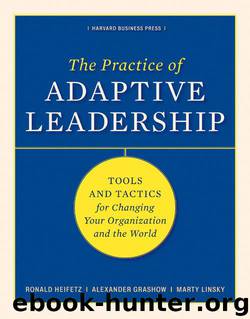
Author:Heifetz, Ronald A. & Linsky, Marty & Grashow, Alexander [Heifetz, Ronald A.]
Language: eng
Format: azw3
ISBN: 9781422105764
Publisher: Harvard Business Review Press
Published: 2009-05-17T16:00:00+00:00
Seven Steps to Orchestrating Conflict
1. Prepare. Before bringing your organization’s factions together and surfacing the conflict, do your homework. Where does each faction stand on the key elements of the conflict? What do they care about the most? What losses do they fear? Talking to them in advance helps you acquire the informal authority you will need to retain their trust when the rough moments come.
2. Establish ground rules. Propose rules making it safe to discuss the conflict, such as committing to confidentiality, staying in the room with PDAs and computers off, depersonalizing the conflicts, and brainstorming. Set the agenda. Frame the issues with the overall mission and the current adaptive challenge. Tell them that it is up to everyone to keep the work issues at the center of attention at all times. To warm up, you might use exercises and cases from other settings to work the issues by analogy rather than directly.
3. Get each view on the table. Invite each faction to articulate the values, the loyalties, and the competencies that inform each of their perspectives on the adaptive challenge and its various related work issues. What commitments do they have to others who are not in the room, and what perspectives do those people have on the challenge? What do they see as their potential and nonnegotiable losses?
4. Orchestrate the conflict. Starkly but evenhandedly, articulate the competing claims and positions you are hearing. As people begin to appreciate how deeply held the competing values are and how committed each faction is to avoiding taking any losses, the tension will rise. Look for signs that people are seeking to avoid the conflict, such as trying to minimize the differences or change the subject. As orchestrator, keep reminding people of the purpose, why it is that they are going through this hard patch.
5. Encourage accepting and managing losses. Give each person or faction an opportunity to reflect more fully on the nature of the losses they would be asking each of their factions to accept. Tell them that some losses will be necessary, but give everyone time to sit with these losses (maybe hours, but also maybe days, weeks, or months). Ask them to consider how they are going to deal with constituents, and how they might go about refashioning constituents’ expectations and loyalties. Ask them to continue to reflect among themselves while maintaining confidentiality.
6. Generate and commit to experiments. Discuss individual experiments for dealing with constituents and collective experiments for tackling the adaptive challenge. Generate a consensus to go with several experiments for tackling the adaptive challenge, in sequence and/or at the same time, as it makes sense, with a shared commitment to get back together to evaluate the results of both kinds of experiments when enough data has been generated for lessons and insights.
7. Institute peer leadership consulting. Individual and collective commitments to go forward will be hard to make because they require decisions about who will take what losses, how each of them will bring the
Download
This site does not store any files on its server. We only index and link to content provided by other sites. Please contact the content providers to delete copyright contents if any and email us, we'll remove relevant links or contents immediately.
Hit Refresh by Satya Nadella(9109)
The Compound Effect by Darren Hardy(8908)
Change Your Questions, Change Your Life by Marilee Adams(7718)
Nudge - Improving Decisions about Health, Wealth, and Happiness by Thaler Sunstein(7679)
The Black Swan by Nassim Nicholas Taleb(7090)
Deep Work by Cal Newport(7042)
Rich Dad Poor Dad by Robert T. Kiyosaki(6579)
Daring Greatly by Brene Brown(6489)
Principles: Life and Work by Ray Dalio(6388)
Playing to Win_ How Strategy Really Works by A.G. Lafley & Roger L. Martin(6188)
Man-made Catastrophes and Risk Information Concealment by Dmitry Chernov & Didier Sornette(5981)
Digital Minimalism by Cal Newport;(5740)
Big Magic: Creative Living Beyond Fear by Elizabeth Gilbert(5726)
The Myth of the Strong Leader by Archie Brown(5482)
The Slight Edge by Jeff Olson(5399)
Discipline Equals Freedom by Jocko Willink(5358)
The Motivation Myth by Jeff Haden(5192)
The Laws of Human Nature by Robert Greene(5138)
Stone's Rules by Roger Stone(5065)
